
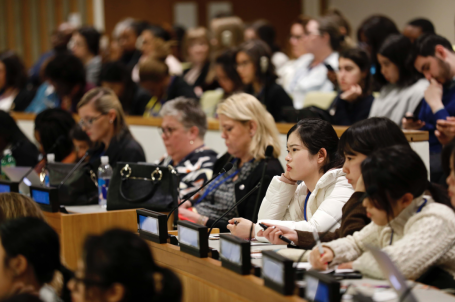
The sixty-fifth session of the Commission on the Status of Women was held from 15 to 26 March 2021 at the United Nations in New York. In light of the evolving COVID-19 global pandemic, and taking into account the latest guidance from the United Nations Secretary-General and the World Health Organization (WHO), CSW65 took place in a hybrid format with mostly virtual meetings.
PPSEAWA was a co-sponsor of two Side Events organized by Permanent Missions and UN entities:
16 March 2021. CSW65 Side Event: Women’s and Children’s Health and Well-being: Implementing Universal Health Coverage (UHC) and the Amelioration of Non-Communicable Diseases (NCDs) in the Context of COVID-19. Organizers: Permanent Mission of Jamaica to the United Nations; Permanent Mission of Thailand to the United Nations; WHO Office at the United Nations, New York; International Council of Women (ICW-CIF); Communications Coordination Committee for the United Nations (CCCUN); Pan Pacific and South East Asia Women’s Association International (PPSEAWA). Access to UHC includes physical and mental health and neurological conditions, the inclusion of mental health in primary care services, as well as the need for disaggregated data to develop comprehensive health policies and are essential to address mushrooming non-communicable diseases (NCDs) which includes the five major burdens of disease worldwide (heart disease, cancer, diabetes, respiratory illnesses, and mental health and neurological conditions) especially for women and children. These must be addressed in the context of COVID-19 to accomplish the SDGs. Examples of successful and replicable programs and research from Australia, Europe, Asia, Caribbean, and U.S. were discussed,
March 24. CSW65 Side Event: We Have Your Back: Breaking the cycle from online
harassment to threats to violence against women and girl leaders. Organizer: Inter-Parliamentary Union, the League of Women Voters of United States, Albania, Australia, UN Women and NGOs: ADIN, FAWCO, IAWRT, ICJW, PPSEAWA International. Discussion of available research on the impact of online violence, preventive actions and good practices – including legal, grassroots, professional and academic perspectives – for breaking the cycle from online harassment to threats to violence against women and girl in political leadership. This event panelists addressed how States, information and communication technology (ICT) companies, and other stakeholders can urgently eradicate online violence against women and girl leaders.
PPSEAWA International also co-sponsored five parallel events in the CSW-NGO Forum:
March 11. “The Crucial Role of Women in Providing Effective Leadership to End the Trafficking of Women and Girls.” Sponsor: CSTIP – NGO Committee to Stop Trafficking in Persons, co-sponsor PPSEAWA International. Dr Raj Abdul Karim was a featured speaker.
March 15. “Role of NPOs/NGOs in formation of public policies.” Sponsor: PPSEAWA Taiwan. Dr. Mariko Fujisawa (PPSEAWA Japan) and Yukiko Takezawa (PPSEAWA Japan) were panelists.
March 16. “Feminist Leadership Led the Way for Gender Equality and Inclusive Future.” Sponsor: PPSEAWA Program Development Committee. Panelists included Mondhiya Bhangsbha (PPSEAWA Thailand), Regina Chen (PPSEAWA Taiwan), Dr. Chaiskran Hiranpruk (PPSEAWA Thailand), Dr. Susan Iwamura (PPSEAWA Hawaii), and Helen Yang (PPSEAWA Taiwan).
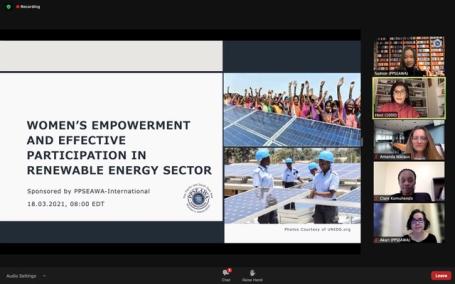
March 18. “Women’s Empowerment and Effective Participation in the Renewable Energy Sector.” Sponsor: PPSEAWA International. Panelists included: Kesinee Dulyarat (PPSEAWA USA), Dr. Munirah Mohd Hassan (PPSEAWA Malaysia), Dr. Sumon Vangchuay (PPSEAWA Thailand), and Akari Yamada (PPSEAWA USA).
Renewable energy, also known as green or clean energy, is intimately tied to climate justice. We must acknowledge its environmental, socio-economic, as well as humanitarian implications.
- The growth of renewables sector also creates jobs, alleviates poverty and improve livelihoods of women, their families and low-income communities in many parts of the world. Access to clean energy such as solar and wind improves safety and health for women and girls who are the primary users of energy in the household. Household air pollution kills over 4 million people every year – women and girls dying prematurely due to harmful smoke from indoor fires used for cooking. Alternative fuel to firewood can reduce the exposure of women to sexual violence when they go out to look for wood and can free up time for other pursuits. Solar-powered lamps enable them to work, cook, study, socialize.
- Renewables have great potential to better the lives of low-income communities. Women are not just energy users.
Our esteemed panelists demonstrated that women are becoming a key part of the value chain in the renewables sector as builders, networkers, educators, entrepreneurs and decision-makers.
March 24. “Reviewing Social and Economic Support Systems for Vulnerable Women.” Sponsor Soroptimist International, with co-sponsor PPSEAWA International.